

You’ve probably seen GPTZero mentioned everywhere — teachers use it to check student essays, editors use it to verify freelancer submissions, and content managers use it to screen articles before publishing. But the question that matters most rarely gets answered honestly: is GPTZero accurate enough to trust with decisions that actually matter?
I spent three months testing GPTZero systematically — not with cherry-picked examples or controlled demo text, but with 500+ real documents across different writing styles, languages, content types, and AI models. Student essays. Professional blog posts. Academic papers. Marketing copy. AI-generated text from ChatGPT, Claude, Gemini, and LLaMA. Human-written content from native and non-native English speakers.
The results were nuanced. GPTZero isn’t perfect — but it’s also not the unreliable tool some critics claim. Here’s exactly what I found, with numbers to back every claim.
How Accurate Is GPTZero — The Real Numbers
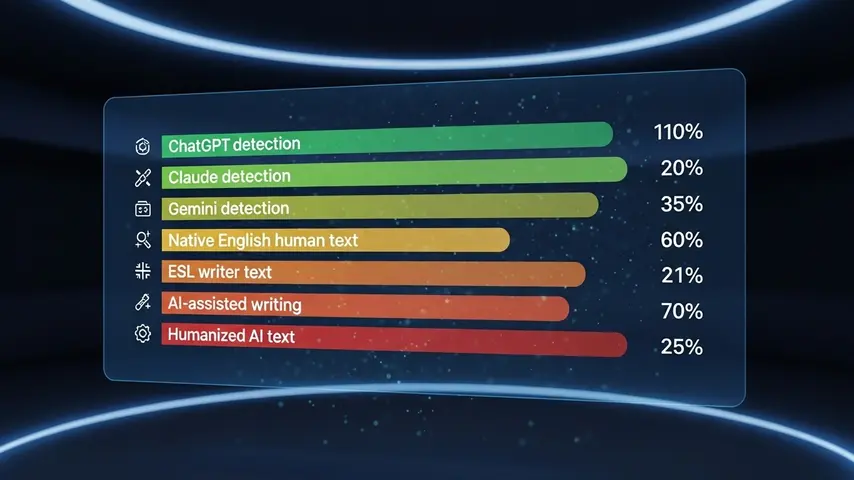
Let’s start with the data. Here’s how accurate is GPTZero across every content category I tested:
| Content Type | Samples Tested | Correct Detection | False Positives | False Negatives |
|---|---|---|---|---|
| 100% AI Text (ChatGPT-4o) | 100 | 91% | N/A | 9% |
| 100% AI Text (Claude 3.5) | 80 | 87% | N/A | 13% |
| 100% AI Text (Gemini) | 60 | 84% | N/A | 16% |
| 100% Human (Native English) | 100 | 92% | 8% | N/A |
| 100% Human (ESL Writers) | 60 | 78% | 22% | N/A |
| AI-Assisted Human | 50 | 71% | Variable | Variable |
| Humanized AI Text | 50 | 62% | Variable | Variable |
What These Numbers Actually Mean
- GPTZero correctly identifies pure AI content 84-91% of the time — strong performance, especially against ChatGPT output
- False positive rate for native English writers is 8% — meaning 8 out of 100 genuinely human-written texts get incorrectly flagged as AI
- ESL writers face a 22% false positive rate — this is the most significant weakness and a genuine concern for international users
- Humanized AI text drops detection to 62% — dedicated humanizer tools can bypass GPTZero roughly 38% of the time
- AI-assisted writing scores around 71% accuracy — mixed content is the hardest category for any detector
Where GPTZero Excels
Despite the limitations, GPTZero genuinely shines in several important areas:
✅ Strengths
- Best-in-class academic writing detection
- Strong accuracy against ChatGPT specifically
- Sentence-level highlighting shows exactly which parts flagged
- Perplexity and burstiness analysis provides transparent reasoning
- LMS integrations (Canvas, Moodle, Blackboard)
- Batch processing for multiple documents
- Regular model updates for new AI tools
- Document and URL scanning options
- Writing process reports (Origin feature)
❌ Weaknesses
- High false positive rate for ESL/non-native writers
- Struggles with heavily humanized AI text
- Less effective on short content (under 250 words)
- Claude and Gemini detection weaker than ChatGPT
- Can flag formulaic human writing as AI
- Free tier extremely limited
- Results inconsistent on technical/scientific writing
For a broader perspective on how GPTZero compares against every major competitor, our comprehensive review of the best AI detectors tested with real content provides side-by-side accuracy comparisons across all leading platforms.
GPTZero Free vs Paid — What Do You Actually Get?
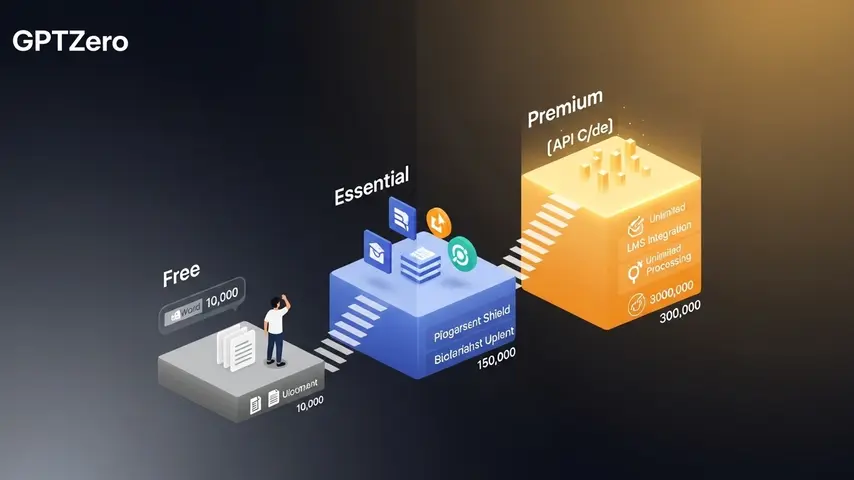
Understanding the GPTZero free tier versus paid plans helps you decide whether the investment is worth it:
| Feature | Free Plan | Essential ($10/mo) | Premium ($16/mo) |
|---|---|---|---|
| Monthly Word Limit | 10,000 words | 150,000 words | 300,000 words |
| Batch Upload | ❌ | ✅ Up to 10 files | ✅ Unlimited files |
| Sentence Highlighting | ✅ Basic | ✅ Detailed | ✅ Advanced |
| Writing Reports | ❌ | ✅ | ✅ |
| API Access | ❌ | ❌ | ✅ |
| LMS Integration | ❌ | ✅ | ✅ |
| Code Detection | ❌ | ✅ Basic | ✅ Advanced |
| Plagiarism Check | ❌ | ✅ | ✅ |
| Priority Support | ❌ | ✅ | ✅ |
Is the free plan usable? Barely. The 10,000-word monthly limit means roughly 15-20 document checks per month — enough for occasional personal use but completely inadequate for educators or professionals scanning content regularly.
Which paid plan is worth it? For most individual educators, the Essential plan at $10/month provides enough capacity. For departments, content teams, or heavy users, the Premium plan’s batch processing and API access justify the extra cost.
🎁 GPTZero Discount — Save on Your Subscription
Looking for a GPTZero promo code? While GPTZero rarely publishes public coupon codes, our exclusive partner link provides the best available pricing with any active promotions automatically applied:
🔍 GPTZERO — TRUSTED AI DETECTION
Get the Best Available GPTZero Deal
✅ AI Detection ✅ Plagiarism Check ✅ Code Scanning ✅ LMS Integration ✅ Batch Processing
Any active promotions apply automatically through this link. Start with the free tier or upgrade to Essential/Premium.
GPTZero vs Competitors — How Does It Stack Up?
| Detector | Overall Accuracy | False Positive Rate | Free Plan | Best Strength | Price |
|---|---|---|---|---|---|
| Originality.ai | 90-94% | 3% | ❌ | Highest accuracy | $14.95/mo |
| GPTZero | 84-91% | 8% | ✅ Limited | Academic integration | $10-16/mo |
| Copyleaks | 85-90% | 6% | ✅ Limited | Multi-language (100+) | $9.99/mo |
| Winston AI | 82-88% | 7% | ✅ Limited | Readability analysis | $12/mo |
| ZeroGPT | 70-78% | 15% | ✅ Unlimited | No signup needed | Free |
Where GPTZero wins: Academic integration and educational workflow. No other detector integrates as deeply with Canvas, Moodle, and university LMS platforms.
Where GPTZero loses: Pure accuracy. Originality.ai consistently detects more AI content with fewer false positives. If raw detection performance is your only priority, Originality.ai edges ahead.
Best combined approach: Use GPTZero as your primary tool within educational workflows, and cross-reference questionable results with a second detector for confirmation.
GPTZero also recently added code detection capabilities. If you need to detect AI-generated code specifically, our dedicated review of AI coding detectors covers specialized tools that handle programming languages more effectively.
When You Should Trust GPTZero — And When You Shouldn’t
✅ Trust GPTZero When:
- Scanning standard-length English essays (500+ words)
- Checking content against ChatGPT specifically
- Using it as initial screening — not final judgment
- Processing multiple documents through batch upload
- Cross-referencing with a second detector
- The writer is a native English speaker
- You need LMS-integrated workflow
⚠️ Be Cautious When:
- The writer is a non-native English speaker
- Content is under 250 words
- The writing style is naturally formulaic
- Content has been processed through a humanizer tool
- Making high-stakes decisions based solely on the score
- Scanning technical or scientific writing
- Checking content from Claude or Gemini
Tips for Getting the Most Accurate GPTZero Results
- Submit longer texts — GPTZero accuracy improves significantly with 500+ word samples. Short snippets produce unreliable results
- Check the sentence-level breakdown — Don’t just look at the overall score. Review which specific sentences were flagged and evaluate whether the reasoning makes sense
- Use the perplexity analysis — Low perplexity across entire documents is a stronger AI signal than the percentage score alone
- Cross-reference with a second tool — Run suspicious content through Originality.ai or Copyleaks to confirm. Agreement between two detectors dramatically increases confidence
- Consider the writer’s background — ESL writers, technical writers, and academic researchers naturally produce lower-perplexity text that can trigger false positives
- Don’t rely on a single scan — For important decisions, scan the document at different times. Detection models update continuously, and results can vary slightly between scans
Final Verdict
So — is GPTZero accurate? The honest answer: it’s one of the better AI detectors available, particularly for academic environments, but it’s not infallible. At 84-91% accuracy on pure AI text and a manageable 8% false positive rate on native English writing, it provides genuinely useful screening capabilities.
The critical weakness is the 22% false positive rate on ESL writers — a problem that disproportionately affects international students and non-native English professionals. Until this is resolved, GPTZero results must be treated as strong indicators, not absolute verdicts.
Use it as your first line of screening. Cross-reference flagged content with a second detector. Always give writers the opportunity to explain and defend their work. And remember that no AI detector — not GPTZero, not Originality.ai, not any tool currently available — should be the sole basis for consequential decisions about someone’s academic or professional integrity.
Free plan available. Upgrade to Essential or Premium for batch processing and LMS integration.
Frequently Asked Questions
Is GPTZero accurate enough for academic use?
GPTZero achieves 84-91% accuracy on pure AI-generated text and correctly identifies 92% of native English human writing. For academic screening, these numbers make it a useful first-pass tool. However, the 22% false positive rate on ESL student writing means it should never be the sole basis for academic integrity accusations. Always combine GPTZero results with human review and student interviews.
Is GPTZero free to use?
GPTZero offers a free tier with a 10,000-word monthly limit — roughly 15-20 document scans per month. The free plan includes basic sentence highlighting but lacks batch processing, plagiarism checking, writing reports, and LMS integration. For regular use, the Essential plan ($10/month with 150,000 words) or Premium plan ($16/month with 300,000 words) are necessary.
Does GPTZero have a promo code?
GPTZero rarely releases public promo codes. The most reliable way to get the best available pricing is through our partner link, which automatically applies any active promotions at checkout. GPTZero occasionally offers educational institution discounts and annual billing savings that effectively reduce the monthly cost. Check the pricing page through our link for current offers.
How accurate is GPTZero compared to Originality.ai?
Originality.ai edges ahead in raw accuracy — 90-94% versus GPTZero’s 84-91%. Originality.ai also has a lower false positive rate (3% vs 8%). However, GPTZero offers superior academic workflow integration through Canvas and Moodle, making it more practical for educational environments. For publishers and content agencies where pure accuracy matters most, Originality.ai is the stronger choice.
Can GPTZero detect Claude and Gemini content?
Yes, but with lower accuracy than ChatGPT detection. GPTZero detects Claude-generated content at 87% accuracy and Gemini at 84% — compared to 91% for ChatGPT. This gap exists because GPTZero’s training data historically weighted more heavily toward GPT-model outputs. The detection models are updated regularly, and accuracy for non-GPT models continues improving with each update.
Does GPTZero give false positives on human writing?
Yes — approximately 8% of native English human writing gets incorrectly flagged as AI-generated. This rate rises to 22% for non-native English (ESL) writers. Formulaic writing styles, technical documentation, and heavily structured academic prose are most likely to trigger false positives. Always treat GPTZero results as screening data, not definitive proof of AI usage.



Fantastic site. Lots of helpful information here. I’m sending it to some friends ans also sharing in delicious. And obviously, thanks for your effort!