


Let’s be honest — the internet is flooded with AI writing tools right now. Every week there’s a new one promising to write 10x faster, rank on page one, and basically do your job for you.
But here’s the thing most people don’t tell you: AI writing tools are only as good as the person using them.
In this guide, we’re breaking down what actually works, what to avoid, and how to use an AI content generator the right way — so your content ranks, reads well, and doesn’t sound like a robot wrote it at 3am.
Whether you’re a blogger, a freelancer, or running a content team, this guide is for you. Let’s dig in. 👇
What Are AI Writing Tools (And Why Everyone Is Using Them)
Simply put, AI writing tools are software powered by large language models (LLMs) that help you generate, edit, or improve written content. Think blog posts, product descriptions, email copy, social captions — the works.
The most popular models behind these tools include OpenAI’s GPT-4o, Google’s Gemini, and Anthropic’s Claude. Each has different strengths, but they all share one goal: help you write faster.
Here’s why people are genuinely excited about them:
- ⚡ Speed — A first draft in minutes, not hours
- 🧠 Ideation — Endless topic ideas, angles, and outlines
- 📈 SEO assistance — Many tools include keyword targeting features
- 💸 Cost efficiency — Reduce outsourcing costs for basic content
According to a 2024 HubSpot report, 64% of marketers said AI tools had already helped them improve their content production output. That number has only gone up heading into 2026.
But speed without strategy gets you nowhere. Let’s look at the tools worth your time.

Best AI Writing Tools Worth Trying in 2026
There are dozens of options out there, but these are the ones consistently delivering results for content creators and SEO professionals:
| Tool | Best For | SEO Features | Free Plan |
|---|---|---|---|
| ChatGPT (GPT-4o) | Versatile writing & ideation | Limited (manual) | ✅ Yes |
| Claude (Anthropic) | Long-form, nuanced content | Limited (manual) | ✅ Yes |
| Surfer AI | SEO-first article writing | ✅ Built-in NLP scoring | ❌ Paid only |
| Writesonic | Marketing copy & blogs | ✅ Keyword optimization | ✅ Limited free |
| Jasper AI | Brand voice & teams | ✅ Surfer integration | ❌ Paid only |
| Copy.ai | Short-form & social copy | ⚠️ Basic | ✅ Yes |
💡 Quick take: If budget is tight, start with ChatGPT or Claude. If SEO is your main goal, Surfer AI or Writesonic are worth the investment because they combine content generation with real-time keyword guidance.
⚠️ Heads up: No AI content generator should publish raw output directly. Every piece needs a human edit pass — for accuracy, tone, and originality. Google’s helpful content system rewards content written for people, not for algorithms.
How to Use SEO Writing AI Without Losing Your Voice
This is where most people go wrong. They paste a keyword into an SEO writing AI tool, hit generate, and publish. The result? Generic content that ranks for nothing and helps no one.
Here’s a smarter workflow that actually produces results:
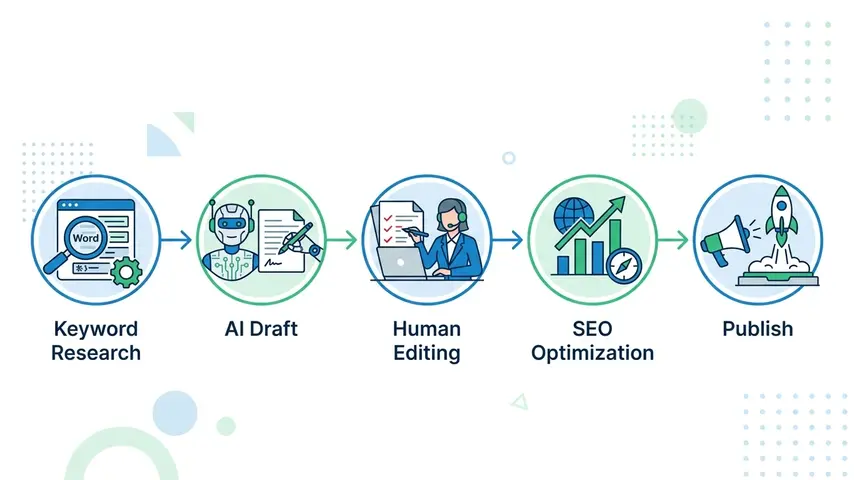
Step 1: Start With Keyword Intent, Not Just Keywords
Before you open any AI tool, ask: What does someone searching this keyword actually want? Informational? A comparison? A tool? Your AI output needs to match that intent or Google won’t rank it — simple as that.
Step 2: Give the AI a Strong Prompt
Garbage in, garbage out. Instead of Write about AI writing tools, try:
“Write a friendly, informative intro for a blog post about AI writing tools. The audience is bloggers and small business owners. Include a statistic about AI adoption in content marketing. Keep it under 150 words.”
Specific prompts produce content that’s actually usable.
Step 3: Edit for Your Voice
AI tools write for the average person. Your readers follow you. After generating, go back through and:
- Replace generic phrases with your own expressions
- Add personal examples or opinions
- Cut repetitive sentences (AI loves to repeat itself)
- Verify every statistic and fact cited
Step 4: Add Original Value AI Can’t Generate
This is your secret weapon. AI can’t share your first-hand experience, case studies from your own site, or genuine opinions. Weave those in, and your content becomes genuinely unique — something search engines and readers both reward.
Speaking of ranking smarter, if you’re also trying to boost video content alongside your blog, check out this YouTube backlink generator to strengthen your video SEO strategy as well.
AI Content Generator Tips That Actually Work
Beyond the basics, here are the less-obvious tips that separate good AI-assisted content from great content:
🎯 Use AI for Structure, Not Just Text
One of the best uses of an AI content generator? Building outlines. Ask it to create 10 different article structure options for your keyword, then pick the best one. This alone saves hours of planning time.
🔁 Repurpose With AI Efficiency
Got a long blog post? Use AI to turn it into a Twitter thread, email newsletter intro, or LinkedIn post. The original human-written content stays at the center — AI just helps you extend its reach.
🔍 Use AI to Find Content Gaps
Paste your competitor’s article into Claude or ChatGPT and ask: “What questions does this article NOT answer that someone searching [keyword] might have?” You’ll instantly find angles that let you outperform existing content.
📝 Combine AI With Proper Content Frameworks
If you’re working on prompts and templates alongside your content workflow, exploring solid vibe coding prompts and templates can help you structure your AI interactions more effectively for repeatable results.
Common Mistakes to Avoid With AI Writing Tools
Let’s keep it real — most people using AI writing tools are making at least one of these mistakes:
- Publishing without editing — Raw AI output is a starting point, never a finished product. Always edit for accuracy, tone, and originality before hitting publish.
- Ignoring E-E-A-T signals — Google values Experience, Expertise, Authoritativeness, and Trust. AI can’t provide your personal experience. You have to add that layer manually.
- Keyword stuffing with AI help — Some users ask AI to “include this keyword 20 times.” That’s a fast track to a Google penalty. Keep density natural — aim for 1–2% maximum.
- Not fact-checking — AI hallucinates. It will confidently cite a study that doesn’t exist or get statistics wrong. Always verify every data point against a real source.
- Skipping off-page SEO — Great content still needs links to rank. If you’re not thinking about your overall link-building strategy, even the best AI-assisted content will struggle to gain traction. Exploring guest posting services is one reliable way to build authoritative backlinks that support your content’s ranking potential.
🚨 Remember: Google’s March 2024 core update specifically targeted AI-generated content that provides little original value. The tools are safe to use — but only when paired with genuine human insight and editorial judgment.

Frequently Asked Questions About AI Writing Tools
Are AI writing tools good for SEO?
Yes — when used correctly. AI writing tools can help you create well-structured, keyword-aware content at scale. However, they work best when combined with human editing, original insights, and a solid off-page SEO strategy. AI alone won’t get you to page one.
Can Google detect AI-generated content?
Google has stated it doesn’t penalize AI content outright — it penalizes low-quality content, regardless of how it was made. That said, pure AI output with no human editing often lacks the experience signals (E-E-A-T) that help content rank. Edit thoroughly and add original value.
What is the best free AI content generator?
For general writing, ChatGPT (free tier) and Claude (free tier) are both excellent starting points. For SEO-specific content generation with keyword guidance, Writesonic’s free plan offers limited but useful functionality. The best free tool depends on your specific use case.
How do I use SEO writing AI without sounding robotic?
The key is treating AI output as a rough draft, not a final product. After generating, rewrite the intro in your own voice, add personal examples, cut any filler phrases, and make sure the tone matches your brand. Read it out loud — if it sounds strange, rewrite that section.
Do I still need backlinks if I use AI writing tools?
Absolutely. AI tools help with on-page content quality, but off-page signals like backlinks remain one of Google’s strongest ranking factors. Even perfectly written AI-assisted content needs quality links to compete in competitive niches. Content and link-building work together — neither replaces the other.
Final Thoughts
AI writing tools are genuinely useful — but they’re tools, not replacements for human creativity and strategy.
The people winning with SEO writing AI right now aren’t the ones generating the most content. They’re the ones using AI to move faster while still bringing their own expertise, experience, and voice to every piece they publish.
Start small. Pick one tool. Use it to speed up your drafting process, not replace your thinking. Edit everything. Add your own perspective. And always remember — the goal isn’t to publish AI content. The goal is to publish great content, faster.
That’s a goal AI can definitely help you reach. 🚀
Found this guide helpful?
Share it with someone building their content strategy — and drop a comment below with your favourite AI writing tool. We read every one. 💬


